
 Member Login



What Do Actuaries Do?
Imagine someone who’s a financial superhero, helping people and businesses prepare for what might happen next. That’s an actuary! Actuaries use math, statistics, and logic to solve tricky problems, especially those involving money and things that are uncertain in the future. Think about these examples:
- Insurance: How much should an insurance company charge for car insurance or health insurance? An actuary figures out the fair price, making sure the company can pay out claims when needed.
- Pensions: If your parents are saving for retirement, an actuary helps make sure their pension fund is investing wisely, balancing how much money it could make with how risky those investments are.
- Banks: When someone gets a home loan, an actuary helps banks understand the risk that some customers might not be able to pay back their debt.
Basically, actuaries take confusing future possibilities and make them clear and understandable. This helps people and businesses plan confidently and get fair deals in a world that’s always changing.
They’re known for finding smart, practical solutions to big problems, always thinking about the long term. They’re clever with numbers, think outside the box, and always act with high standards and ethics, making sure things are fair for everyone involved.
What Skills Do Actuaries Have?
Actuaries undergo rigorous academic and practical training in order to master a wide range of skills, including:
- Analysing and managing uncertainty
- Financial and mathematical modelling, including mortality and morbidity rates
- Evaluating financial consequences
- Analysis of risk and risk management
- Scientific pricing and reserving techniques
- Asset/liability management
- Overall financial management
- Communication of complex financial concepts in understandable terms
Designations
An ASSA designation refers to a professional qualification awarded by the Actuarial Society of South Africa (ASSA). These designations signify that an individual has met rigorous academic, examination, and practical experience requirements, certifying them as a qualified actuary in South Africa.
ASSA supports qualifications across the following designations:
- TASSA (Technical member)
- AMASSA (Associate member)
- FASSA (Fellowship member)
- CERA (Chartered Enterprise Risk Actuary)
More information about ASSA designations.

Pathways to Becoming an Actuary
Take a look at the following videos on the pathways to becoming an Actuary
Career Paths for Actuaries
Where Do Actuaries Work?
Actuaries have an extensive skill set, which makes them very valuable in the workplace. Although the list is not exhaustive, these are some areas where the actuarial toolkit has added value:
- Insurance: investigating, analysing and explaining a wide range of numerical information to create and price polices, or to ensure they have sufficient funds to cover claims.
- Pensions: designing and advising on company pension schemes, especially placing a value on accumulated pension commitments.
- Investments: involved in research and on the pricing and management of investments, particularly in mitigating the risk of investments, and often using their understanding of insurance or pension liabilities to manage the corresponding assets.
- Banking: calculating and quantifying an array of risks faced by these institutions, such as the inability of some borrowers to repay their debt, or the risk of a fall in financial markets.
- Healthcare: investigating, analysing and explaining a wide range of health and medical information to price contributions to medical schemes or assess the impact on the industry of regulation changes.
- Risk management: assisting businesses to better understand the multiple risks they face holistically and comprehensively, as well as providing assistance and guidance in terms of how to understand their impact and how they can best be managed.
Although many actuaries traditionally work in the financial services industry, many have used their training to branch into wider business fields.
Take a look at the following video clips of professional actuaries in the industries below:
BANKING ACTUARY
LIFE INSURANCE ACTUARY
Becoming An Actuary
It is a difficult road to qualify as an actuary, but the rewards are well worth the effort.
STEP 1
HAVE A STRONG MATHEMATICAL CAPABILITY
You’ll definitely need this to become an actuary. But it’s worth noting that whatever you eventually decide to do, taking maths will broaden your career options.
STEP 2
GET A GOOD DEGREE
Students can enrol directly into university for an actuarial science degree. This will enable you to write a number of the examinations required to qualify as an actuary.
The actuarial profession is also open to individuals in other careers. You can join the actuarial profession and write the examinations with any math-based degree.
STEP 3
FIND AN ACTUARIAL TRAINEE ROLE
Join an actuarial firm and develop your skills while you qualify. There is no age limit for joining the profession. If you’re interested in changing from another career or profession, we usually recommend you undertake one or two of our examinations independently, to assess your skills. Your experience in your current career may be valuable to an actuarial firm, and you may wish to contact actuarial employers directly to discuss your potential.
STEP 4
REGISTER AS AN ACTUARIAL STUDENT & GAIN YOUR QUALIFICATIONS
To become a Fellow of the Actuarial Society or an Associate of the Actuarial Society you must pass our examinations, or be granted exemption from them, and also attain a satisfactory level of work-based skills. This usually takes between three and eight years. You study by distance learning, and many employers offer support for study, some offering paid study leave during your training.
STEP 5
ENJOY A JOB ANYWHERE IN THE WORLD
Within the actuarial profession there are many different and exciting career paths, and once you’re qualified, your skills can take you anywhere. Some actuaries specialise in technical research, while others may focus more on commercial activities. Some go on to be practising specialists in one of the traditional financial fields, with others becoming senior managers in insurance companies or firms of consultants.
STEP 4
REGISTER AS AN ACTUARIAL STUDENT & GAIN YOUR QUALIFICATIONS
To become a Fellow of the Actuarial Society or an Associate of the Actuarial Society you must pass our examinations, or be granted exemption from them, and also attain a satisfactory level of work-based skills. This usually takes between three and eight years. You study by distance learning, and many employers offer support for study, some offering paid study leave during your training.
MATHEMATICS IS OUR FUTURE – IZIBALO SEKUSASA LETHU
Browse the Mathematics Is Our Future – Izibalo sekusasa lethu booklet to see various options to get you started with your future career.

The Current Number of ASSA Members


Fellows
2,057
Associates
282
Technical
1,466
Students
1,920
Affiliates
28
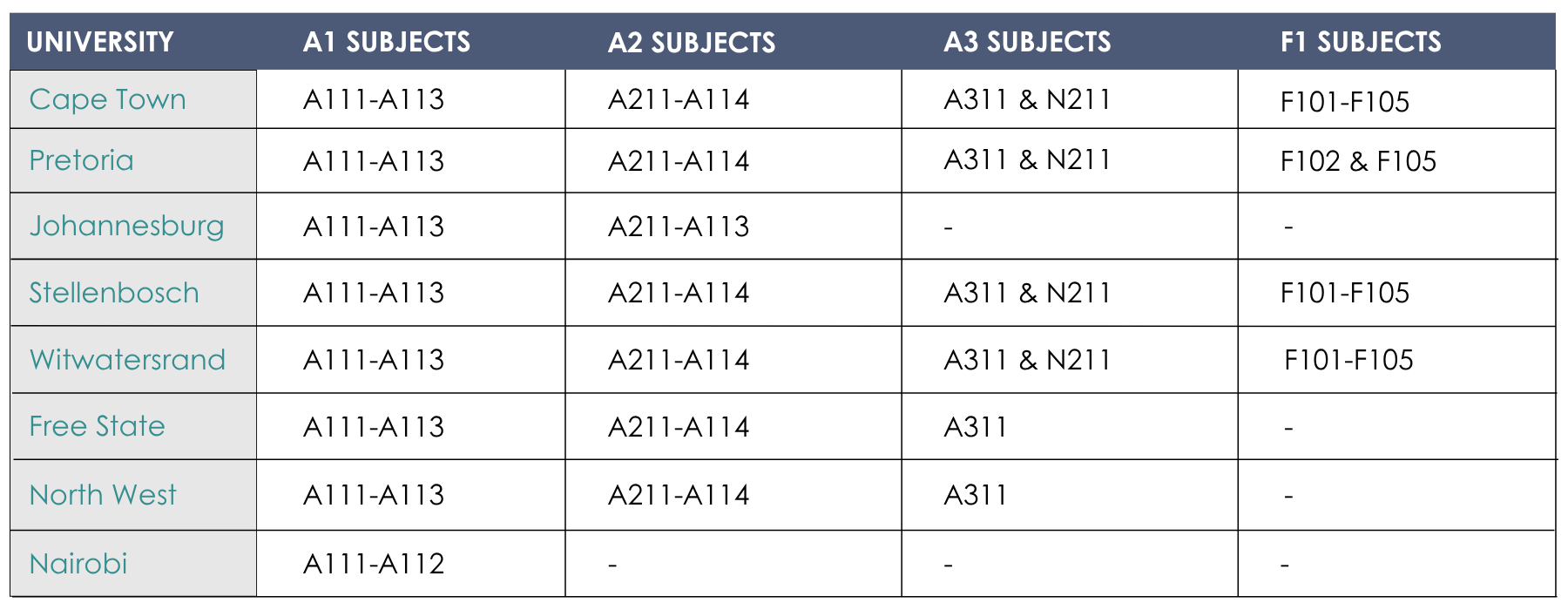
Accredited Universities
Universities that are Accredited with the Actuarial Society
Cape Town
Pretoria
Johannesburg
Stellenbosch
Witwatersrand
Free State
North West
Nairobi
Accredited Subjects per University